Skeleton and Bone Vocabulary in English for Kids
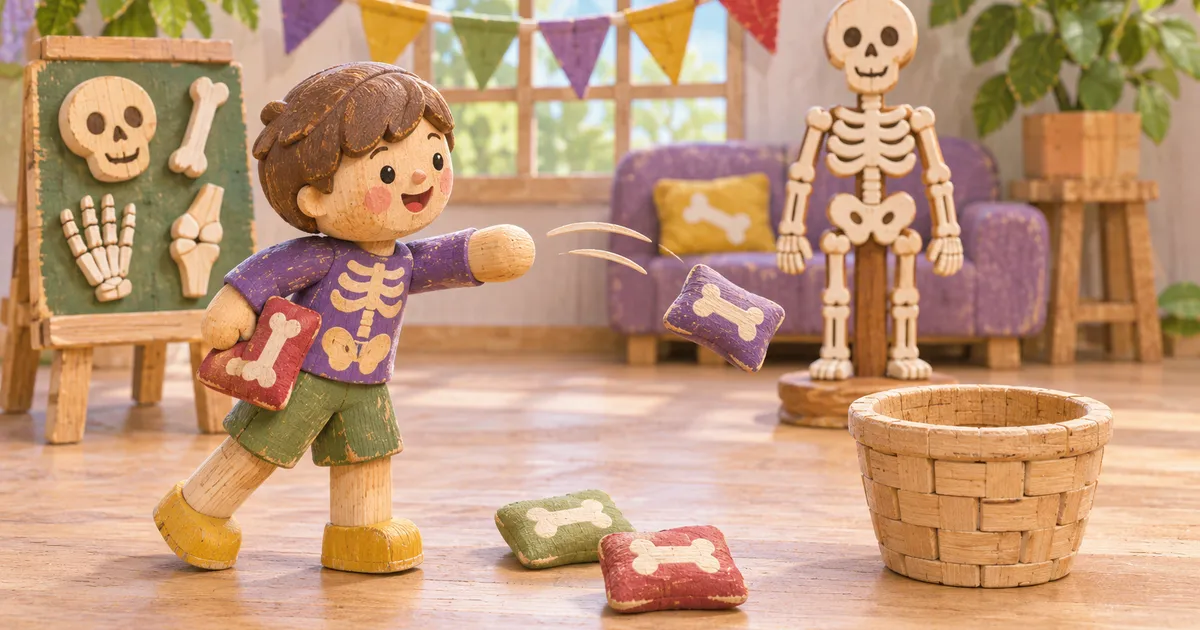
A starter set of Skeleton and Bone Vocabulary in English for Kids covers 20 word groups, from bone and skull to joint and cartilage. Children need not memorise every scientific term at once. Link each word to a body part, action, and short sentence. Begin with parts your child can point to or show through movement, then add femur, vertebra, and pelvis. The activities below develop drawing, speaking, matching, and movement skills across age groups.
📥 Skeleton and Bone Vocabulary Practice
Independent practice for children and teens at home or in the classroom
Leave your email — we'll send the PDF to your inbox.No spam — the PDF plus one short reminder. Unsubscribe anytime.
Key Vocabulary for Bones and the Skeleton
Teach Skeleton and Bone Vocabulary in English for Kids in small groups. Start with six familiar words, then add two or three after your child recognises and uses them. Teach everyday and scientific names together, allowing younger children to use the everyday form first.
Your child should understand each word, locate the body part, and use it in a sentence. The final column provides a model to copy or adapt.
Putting the Words into Context
Make Skeleton and Bone Vocabulary in English for Kids meaningful through three sentence patterns: location, function, and movement. For location, ask, “Where is the skull?” Your child answers, “The skull is in the head.” For function, ask, “What does the rib cage do?” For movement, try, “Which joint bends when you lift your foot?”
Practise familiar verbs: bend, turn, protect, support, move, and join. Models include “The knee bends,” “Bones support the body,” and “The pelvis joins the upper body to the legs.” Older children can connect ideas with because: “The skull is important because it protects the brain.”
Questions strengthen recall. Show a skeleton picture, cover the labels, and ask your child to name three parts. Then reverse the task: say a word and have your child point, draw, or explain. Accept thigh bone before requesting femur.
Activities for Different Ages
With Skeleton and Bone Vocabulary in English for Kids, age shapes the task more than the word list. A younger child can point or move; an older child can compare terms, define them, and explain how parts work together. Choose the row matching your child’s language skills rather than birthday alone.
For a safe craft, children can cut large paper pieces, arrange a skeleton, and connect the joints with paper fasteners. Supervise cutting and small materials. Give short instructions: “Put the skull above the spine” and “Join the femur to the pelvis.”
Practice Ideas for Home and the Classroom
A three-minute practice round is enough. Show five words, hide them, and ask your child to recall as many as possible. Revisit the set later in the week. Spaced practice keeps sessions manageable and gives repeated retrieval opportunities.
Movement games suit mixed language levels. Say, “Touch near your collarbone,” “Bend your knee,” or “Turn your head gently.” Then ask, “Which bone protects the brain?” In multilingual homes, children can identify the part in a known language before giving the English word.
Quick Bone Detective Challenge
Choose a word without naming it. Give three clues: location, appearance, and function. For example: “It is in the chest. It is curved. It helps protect organs.” The answer is rib. Let your child create the next clues.
Try a sorting game: write words on cards and group them under head, upper body, arms, and legs. Words such as joint and cartilage may belong to more than one group. Ask your child to explain the choice.
Common Language Mistakes and How to Correct Them
Children may confuse skeleton and bone. A skeleton is the whole framework; a bone is one part. They may treat knee and kneecap as synonyms. The knee is the wider joint area; the kneecap is one bone at the front.
Correct errors by repeating the full sentence naturally. If your child says, “The ribs protects the chest,” reply, “Yes, the ribs protect the chest.” The conversation continues while your child hears the correct form.
- Choose five skeleton words and say each aloud with your child.
- Point to three bones in a picture and name them together.
- Contrast “bone” and “bones” using one object and two objects.
- Read one anatomy picture book and repeat each corrected phrase clearly.
- Ask four quick questions, then model clear answers without interrupting your child.
When a word has several meanings or pronunciations, Cambridge Dictionary is a useful check before turning it into child-friendly examples.
Frequently Asked Questions
These answers help set the pace and select suitable words for your child.
How Many Bone Words Should Your Child Learn at One Time?
Begin with five or six words your child can locate on a picture or body. Practise short sentences before adding more. Remembering four words with understanding builds a stronger base than repeating fifteen without comprehension. Review older words with one or two new ones to keep the first set active.
Should Young Children Learn Scientific Bone Names?
Teach scientific names beside familiar terms: femur with thigh bone, patella with kneecap, and vertebrae with spine bones. Testing every formal term is unnecessary. Focus first on understanding and confident use, then introduce precise labels gradually.
How Can Your Child Remember Skeleton Vocabulary?
Effective practice for Skeleton and Bone Vocabulary in English for Kids combines seeing, saying, moving, and recalling. Your child can point to the spine, say the word, show its location, and make a sentence. Revisit each word after a gap instead of repeating it in one sitting. Drawing and clue games reinforce memory.
Can Your Child Learn These Words Without an Anatomy Book?
Yes. A skeleton picture, homemade word cards, paper shapes, and movement prompts support beginner practice. Verify unfamiliar scientific terms in a reliable children’s reference. In LearnLink lessons, tutors can adapt speaking and reading tasks to each child’s age, English level, and prior knowledge without making the lesson medical.
Want to see how these ideas work in a real lesson — try a LearnLink trial lesson.
Stay updated on our latest tips and resources by following us on Instagram LearnLink.