How Kids Write Compare-and-Contrast Paragraphs
A compare-and-contrast paragraph shows how two subjects are alike and different through one focus and selected details. How to Write a Compare-and-Contrast Paragraph: A Practical Guide for Kids has three steps: name both subjects, choose a comparison basis, and order the points logically. Children need accurate examples, linking words, and a closing summary. The method suits animals, games, books, places, foods, and school routines.
📥 Compare-and-Contrast Paragraph Builder
A planning, grammar, and revision worksheet for clear compare-and-contrast writing.
Leave your email — we'll send the PDF to your inbox.No spam — the PDF plus one short reminder. Unsubscribe anytime.
What Children Need to Understand
Comparing identifies similarities; contrasting identifies differences. A paragraph should do both. For example, “Cats and dogs are both popular pets, but they communicate in different ways” sets one focus without ranking either animal.
Compare both subjects on the same basis. A bicycle and scooter can be compared by wheels, speed, and use. Comparing a bicycle’s colour with a scooter’s price confuses readers because the details do not match.
The central lesson in How to Write a Compare-and-Contrast Paragraph: A Practical Guide for Kids is selection. A young writer may know ten facts but need only two or three. One strong similarity and one specific difference can form a first paragraph.
Choose Useful Points Before Writing
Make a planning chart with one subject on each side and shared features in the middle. A Venn diagram also works. Record short notes instead of sentences.
Test each detail: Does it relate to both subjects? Does it support the focus? Will readers understand its value? Remove any point that fails a test.
- Subjects: paper books and e-books
- Similarity: both tell stories or share information
- Difference: one uses printed pages, while the other uses a screen
- Main idea: both formats help readers, but they create different reading experiences
When practising How to Write a Compare-and-Contrast Paragraph: A Practical Guide for Kids, ask the child to say the plan aloud. A comparison expressed in two or three connected sentences is ready for writing.
Build the Paragraph One Sentence at a Time

A paragraph needs a topic sentence, support, and a closing sentence. The topic sentence names both subjects and states the comparison. Supporting sentences explain selected similarities and differences through examples.
- Topic sentence: “Trains and buses both carry passengers, but they travel in different ways.”
- Similarity: “Both can take many people on one journey.”
- Difference: “A train follows rails, while a bus travels on roads.”
- Extra detail: “Unlike a train, a bus can use many ordinary streets.”
- Closing sentence: “Both are useful forms of transport, although each suits a different route.”
Tie each supporting sentence to the topic. A bus’s colour adds nothing unless colour belongs to the planned comparison. This rule prevents the paragraph from becoming an unrelated list.
In How to Write a Compare-and-Contrast Paragraph: A Practical Guide for Kids, the closing sentence unites the ideas. It can restate the central point in fresh words but must not introduce another subject or fact.
Use Comparison Grammar Accurately
Linking words define relationships between ideas. Certain words signal similarity; others mark difference. Choose each connector for its meaning instead of adding one to every sentence.
Sentence structure also matters. Place a comma before but when it joins two complete statements: “The city has many shops, but the village has more open land.” When however starts a sentence, place a comma after it.
Paired forms also work: “Both chess and football require planning,” or “Neither activity is easy without practice.” Match the verb to the subject: “Both games are challenging,” not “Both games is challenging.”
Fix Common Mistakes
Weak paragraphs contain mismatched, repeated, or unexplained ideas. Review each sentence and repair these faults.
- Listing without comparing: “A tiger has stripes. A lion has a mane.” Add the link: “A tiger has stripes, whereas a lion has a mane.”
- Changing the basis: Do not compare one animal’s size with another animal’s home. Match size with size and home with home.
- Using only differences: Include at least one meaningful similarity when the task asks for both comparison and contrast.
- Repeating the same connector: Mix clear forms such as both, but, while, and unlike.
- Adding an unsupported opinion: Replace “Bicycles are better” with a specific point, such as “Bicycles can travel farther with less pushing.”
Read the paragraph aloud and underline each linking word. Circle the detail about each subject. The marks expose missing pairs and show whether every sentence supports the comparison.
A final check of How to Write a Compare-and-Contrast Paragraph: A Practical Guide for Kids should cover focus, matched details, connectors, punctuation, and the closing sentence. Correct one error type at a time.
Practise with Short, Guided Tasks
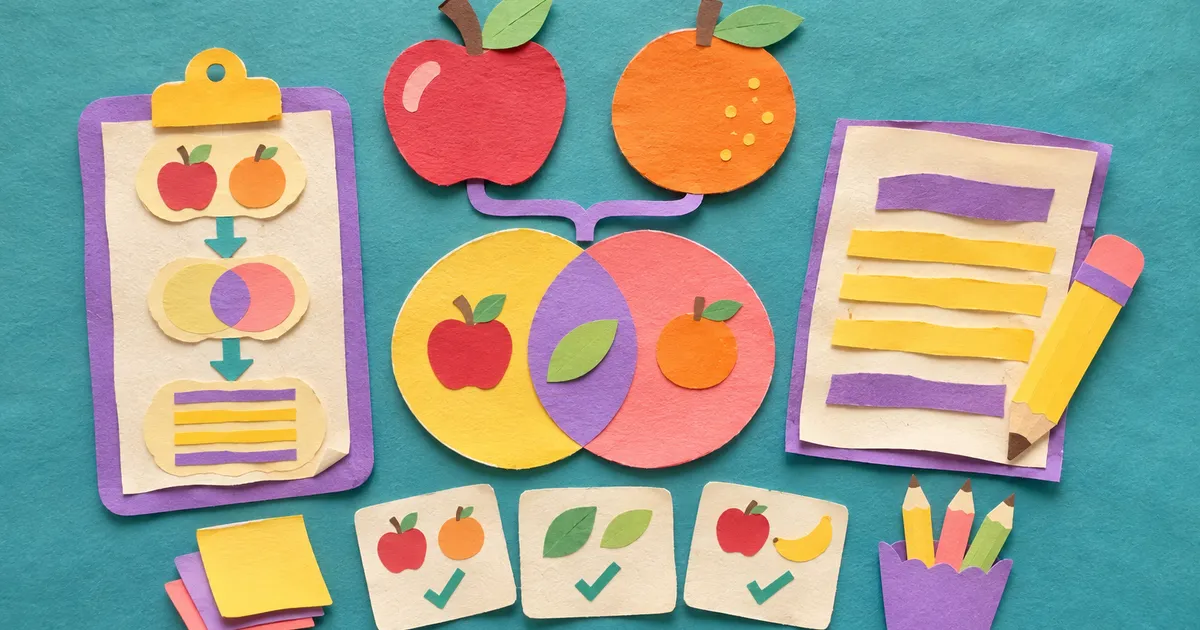
Choose familiar subjects so the child focuses on writing instead of research. Pictures, household objects, story characters, and everyday activities offer enough material for comparison.
For each task, ask the child to explain each linking-word choice. This turns How to Write a Compare-and-Contrast Paragraph: A Practical Guide for Kids into a repeatable method instead of a model to copy.
Fill in the Linking Words
Choose both, but, or whereas: “___ apples and bananas are fruits. Apples can be crisp, ___ bananas are soft. Apples grow on trees, ___ bananas grow on large plants.” Answers: Both, whereas, but.
Combine the Sentences
Join these ideas: “A kite needs wind. A paper aeroplane can fly indoors.” One answer is: “A kite needs wind, whereas a paper aeroplane can fly indoors.” Rewrite it with unlike.
Write a Five-sentence Paragraph
Compare learning from a storybook and a short video. Write one topic sentence, one similarity, two differences, and one closing sentence. Ensure each detail applies to both formats and use at least three linking words.
- Choose two familiar animals, books, or characters your child can compare confidently.
- Ask them to name one similarity and one difference aloud.
- Write a topic sentence that clearly introduces both subjects together.
- Organise supporting details with comparison words such as both, and unlike.
- Review the paragraph together, checking that every sentence supports the main comparison.
When a word has several meanings or pronunciations, Cambridge Dictionary is a useful check before turning it into child-friendly examples.
Frequently Asked Questions
How Long Should a Compare-and-contrast Paragraph Be?
Length depends on age, writing experience, and the task. A beginner can write four or five connected sentences: a topic sentence, one similarity, one or two differences, and a closing sentence. Experienced writers can add evidence and explanation. Strong organisation matters more than a fixed line count.
What Is the Easiest Way to Teach This Paragraph?
Discuss two familiar objects before writing. Ask your child for one shared feature and one difference, then record them in a chart. How to Write a Compare-and-Contrast Paragraph: A Practical Guide for Kids works best when planning, speaking, writing, and checking remain separate steps.
Does Every Paragraph Need Both Similarities and Differences?
If the instruction says “compare and contrast,” include both. Certain tasks use “compare” for similarities and differences; others mean similarities alone. Read the instruction together. If its meaning remains uncertain, one similarity and one difference demonstrate fuller understanding.
Which Linking Words Should a Beginner Learn First?
Start with both, but, while, and unlike. These words cover core relationships across familiar subjects. Add whereas, however, and in contrast after your child builds complete sentences. Accurate connectors beat a long, random list.
How Can a Parent Help Without Writing the Paragraph?
Use this five-step routine and let the child supply every idea and sentence:
- Choose two familiar subjects.
- Ask for one similarity and two differences.
- Check that each point compares the same feature.
- Have the child write five connected sentences.
- Read the paragraph aloud and correct one issue.
Want to see how these ideas work in a real lesson — try a LearnLink trial lesson.
Stay updated on our latest tips and resources by following us on Instagram LearnLink.